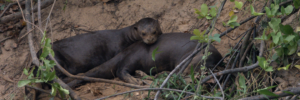
In December 2025, we carried out an expedition in the Paraná River Basin, a strategic region that connects the Atlantic Forest and Pantanal biomes and holds historical records of giant otter occurrence in the Atlantic Forest. This activity is part of a broader project whose main objective is to facilitate the safe recolonization of giant otters across their historical range, focusing on the species’ southernmost distribution limit.
Project activities include gathering information on the current and historical presence of giant otters in the region, strengthening institutional partnerships, and understanding local community perceptions. The expedition was conducted with essential support from ICMBio/Ilha Grande National Park, which played a key role in planning and implementing the field activities. Over the course of the expedition, more than 340 km were surveyed, covering stretches between the municipalities of Guaíra (PR) and Rosana (SP), as well as important tributaries of the Paraná River.

Local engagement: science built through partnerships
The project’s activities are strengthened through collaboration with public institutions such as the Environmental Military Police and local governments. Strategic meetings are essential for information exchange and for expanding Projeto Ariranhas’ presence in the region, reinforcing the importance of multi-sector engagement in biodiversity conservation.
Riverside communities and environmental memory
Visits to riverside communities are an integral part of the activity schedule. During these visits, the team conducts interviews with local residents to collect impressions and valuable accounts related to the species, which will help guide the next steps of Projeto Ariranhas in the region.
Next steps: communication, engagement, and listening
The work carried out in the Paraná River Basin reinforces Projeto Ariranhas’ approach beyond direct species monitoring. It emphasizes dialogue, active listening, the appreciation of environmental memory, and collective knowledge-building. Even in the absence of recently confirmed records, the region remains strategically important for the species and is included among the focal areas of the Brazilian Action Plan for the Conservation of the Giant Otter (PAN Giant Otter).
This project is supported by ZGAP, the Fonds für bedrohte Papageien (FbP), and the Strunden-Papageien-Stiftung (SPS).