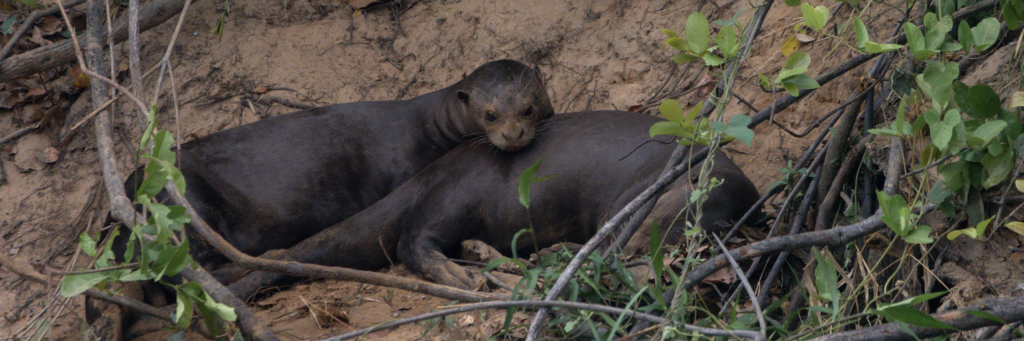
The Giant Otter Project contributes to international publication that sets priorities for giant otter conservation in South America
We are proud to announce the publication of the book “Assessing an Aquatic Icon: A Range-Wide Priority Setting Exercise for the Giant Otter (Pteronura brasiliensis)”, a milestone reference that outlines the next steps for conserving the species across its entire distribution range.
The result of a major international effort, the publication brings together the contributions of 40 experts from 12 countries. It consolidates current knowledge on the biology, ecology, and conservation status of the giant otter, while also identifying key strategic areas for its protection across South America. The book represents an important step toward strengthening public policy, supporting technical decisions, and promoting international cooperation in defense of the sentinel of the waters.
How the initiative began
The process began in 2018, during a workshop held in Puerto Maldonado, Peru, that brought together researchers and institutions from across South America. From the very beginning, The Giant Otter Project was involved through the participation of our president, Caroline Leuchtenberger, who contributed data and insights gained over almost two decades of experience in population monitoring and species conservation in Brazil.
What the publication presents
Organized into 17 chapters, the book covers topics ranging from the biology and ecology of the giant otter to detailed strategic recommendations aimed at strengthening long-term conservation efforts. One of the key outcomes is the identification of Priority Conservation Units (PCUs) — strategic areas with essential ecological characteristics where conservation actions are expected to yield the greatest impact.
These PCUs were defined based on a combination of criteria, including current and potential threats, relative species abundance, historical and current distribution, and the ecological importance of each area. This prioritization aims to guide future research, monitoring, and protection efforts, optimize the use of resources, and support conservation policies across the species’ range.
Why is this publication so important?
Currently listed as Endangered on the IUCN Red List, the giant otter has already lost around 40% of its original distribution range. The species is considered extinct in Uruguay and possibly in Argentina — although recent records offer hope for recolonization. Giant otters face a complex scenario of threats, including habitat destruction, river pollution, climate change impacts, and the expansion of harmful human activities such as gold mining, agriculture, and unregulated tourism.
In this context, the book emerges as a critical tool to focus efforts where they are most urgently needed, fostering collaboration among countries, institutions, and researchers. The publication also underscores the need to expand scientific research in understudied regions, especially in the Amazon, where the species has an irregular distribution and large knowledge gaps still remain.
The Giant Otter Project’s contribution
In addition to participating in the design and development of the publication, The Giant Otter Project provided field data collected during monitoring activities in the Pantanal, Cerrado, and Brazilian Amazon regions. These data were essential for mapping the species’ distribution and identifying emerging conservation challenges.
“This publication is a landmark for giant otter conservation throughout South America. Being among the authors and partners of this international effort is a source of great pride for us and reinforces the value of the daily work we carry out in the field,” says Caroline Leuchtenberger, president and founder of the Giant Otter Project.
The book is available for free in digital format and can be accessed by anyone interested in learning more about the species and the strategies to protect it.